DILLIGAF
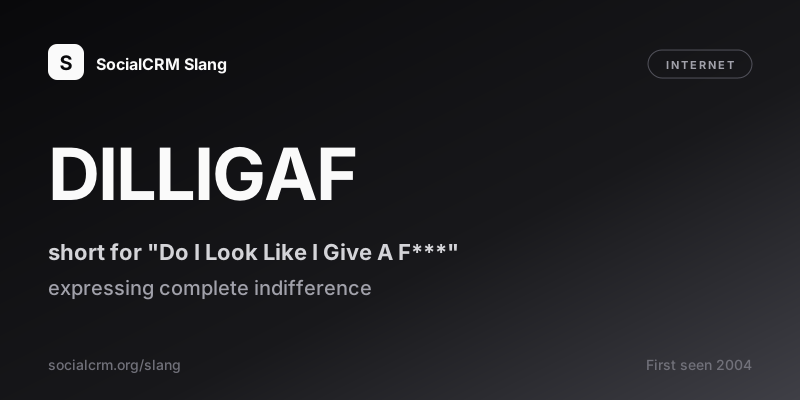
DILLIGAF stands for "Do I Look Like I Give A F***," used to express complete indifference or zero concern about what someone thinks.
The SocialCRM Team
Quick definition
DILLIGAF is an acronym for "Do I Look Like I Give A F***." It functions as a rhetorical question that answers itself in the negative. Someone drops DILLIGAF to signal zero concern about a situation, a criticism, or another person's opinion. It is blunt, often humorous, and unmistakably informal.
What does "DILLIGAF" mean?
DILLIGAF unpacks to "Do I Look Like I Give A F***." The speaker is not genuinely asking whether they look indifferent. They are asserting they are. The question format adds a theatrical edge that makes the phrase more memorable than a simple "I don't care."
The register is casual to aggressive depending on context. Among friends, DILLIGAF can be playful, the typed equivalent of an eye-roll. In a heated exchange, it reads as a flat refusal to engage with someone's concern or judgment. Either way, it closes the conversation on the speaker's terms.
DILLIGAF is almost always typed in all-caps, which amplifies the bluntness. Lowercase "dilligaf" is rarer and often reads as ironic rather than genuinely dismissive. You can browse the full slang index for more attitude-adjacent terms in the same register.
Where does "DILLIGAF" come from?
The phrase "Do I Look Like I Give A F***" circulated in biker and working-class culture through the 1980s and 1990s as a spoken retort. It was cemented as an acronym in 2004 by Australian comedian and musician Kevin "Bloody" Wilson, who released a novelty track titled DILLIGAF that became a cult hit in Australia and the UK.
After the song's release, the acronym spread through early internet forums and novelty merchandise through the mid-2000s. By the early 2010s it had migrated onto Reddit, Facebook pages, and meme sites as a shareable caption. The core meaning has never changed.
How is "DILLIGAF" used?
DILLIGAF works as a standalone reply or as part of a longer sentence. As a standalone, it is a blunt non-answer to a critique or a nosy question. In a sentence, it often opens as a rhetorical setup: "DILLIGAF what they think?" The implied answer is always no.
It shows up in comment sections responding to criticism, in memes about ignoring rules or expectations, and occasionally on real-world slogan merchandise. Its all-caps default signals volume. It is meant to land with emphasis. Unlike many internet phrases that carry an ironic layer, DILLIGAF is usually sincere, or at least performed with a straight face.
Examples of "DILLIGAF" in a sentence
- "They said my car is too loud. DILLIGAF."
- "DILLIGAF what the algorithm thinks, I post when I want."
- "Bro they complained about my playlist. DILLIGAF ong."
- "My boss asked why I came in late. DILLIGAF, I finished all my work."
- "Everyone is saying the ending was bad. DILLIGAF, I loved it."
Related slang
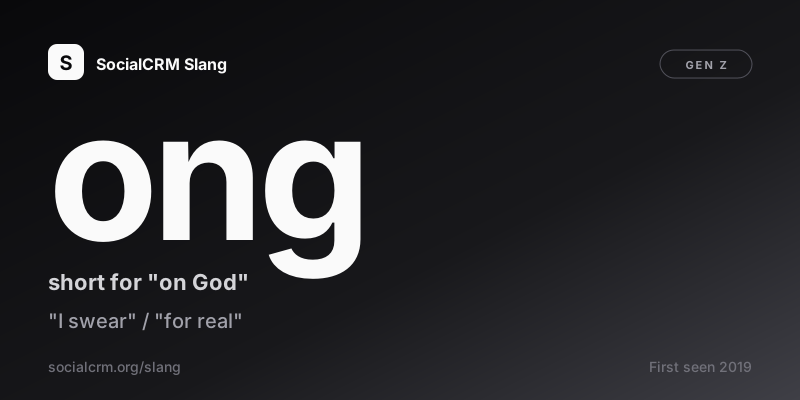
- ong-- "On God." A sincerity marker often paired with DILLIGAF to stress genuine indifference: "DILLIGAF, ong."
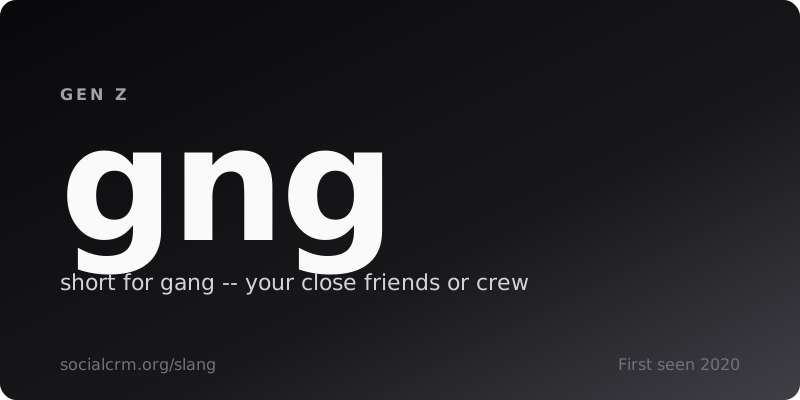
- gng-- "Gang." Your crew. DILLIGAF energy is often directed outward at anyone outside the gng.
- ion-- "I don't." A compressed form that carries similar dismissive weight in casual text.
- ngl-- "Not gonna lie." A softer hedge compared to DILLIGAF's blunt assertion.
FAQ
Is DILLIGAF offensive?
DILLIGAF contains an expletive, so it is adult content in any setting. Among friends it reads as irreverent and humorous. Directed at someone in a genuine confrontation, it is blunt and dismissive. Use it in casual digital spaces only.
Where did DILLIGAF come from?
The acronym was popularized by Kevin "Bloody" Wilson's 2004 Australian novelty song of the same name. The underlying phrase predates the song by at least a decade in biker and working-class slang from the 1980s and 1990s.
Is DILLIGAF the same as IDGAF?
They express similar indifference but from different angles. IDGAF ("I Don't Give A F***") is a statement. DILLIGAF is a rhetorical question. Both signal zero concern, but DILLIGAF adds a theatrical, self-aware edge.
Can DILLIGAF be used humorously?
Yes. Much of its modern usage is self-aware and comedic. The all-caps delivery and the theatricality of spelling out the question make it a natural meme caption format.
TL;DR
- DILLIGAF stands for "Do I Look Like I Give A F***." It expresses complete indifference to a criticism or opinion.
- It was popularized by Kevin "Bloody" Wilson's 2004 Australian novelty song and spread through internet meme culture.
- Use it as a blunt, humorous retort in casual digital contexts. Always informal, always adult content.