ong
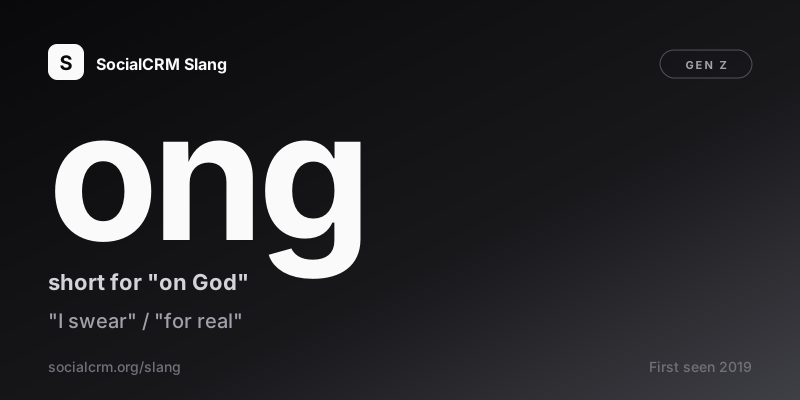
Ong is slang for "on God," an oath of sincerity meaning "I swear" or "for real." Used by Gen Z to emphasize truth or signal strong agreement.
The SocialCRM Team
Quick definition
Ong is internet shorthand for "on God," an oath of sincerity used to stress that something is true. It works like "I swear" or "for real," and Gen Z and Gen Alpha drop it at the end of a statement, or solo as a one-word reply, to signal strong agreement and zero exaggeration.
What does "ong" mean?
Ong is a phonetic compression of the phrase "on God." Saying ong is the typed equivalent of putting your hand on your heart: you are swearing the statement is true. The aliases "on god" and the all-caps "ONG" carry the same weight, with caps reading as slightly louder.
It functions mostly as an interjection, but it slips into adverb territory when it bookends a sentence. "That meal was fire, ong" tags the claim with a sincerity stamp. "Ong, she actually did that" opens the sentence with the oath so the rest lands as a confession of fact.
The register is informal and warm. Ong is not a hedge and not a joke. Unlike many Gen Z words that carry an ironic layer, ong almost always means what it says, which is part of why it spread so fast across the wider glossary you can browse on the slang index.
Where does "ong" come from?
Ong began as a written shortening of "on God," a long-running oath in African American Vernacular English (AAVE). The compressed spelling went mainstream around 2019 as TikTok and Snapchat captions pushed it into the feeds of millions of teens. By 2020 and 2021, it had crossed over into Twitter replies, Discord chats, and Instagram comments, where it remains a common closer.
As with most AAVE-rooted slang, the spread followed the familiar arc: Black creators on TikTok and Snapchat used it natively, the sound and text traveled with viral clips, and the wider Gen Z audience adopted it. Crediting the linguistic origin matters; treating it as a TikTok invention erases where it actually comes from.
How is "ong" used?
Ong sits at the end or the start of a statement and intensifies it. Mid-sentence placement is rare and usually reads as awkward. The speaker is typically Gen Z or Gen Alpha; older millennials use it knowingly, often with a wink, while older generations rarely use it at all.
It is at home in DMs, comment sections, group chats, and short-form video captions. It would feel out of place in a cover letter, a press release, or a school essay. As a single-word reply (just "ong" on its own), it functions like "facts," "real," or "true" -- a quick co-sign that you agree completely.
Examples of "ong" in a sentence
- "That movie was the best one this year, ong."
- "Ong, I have been waiting for this album for months."
- "Bro the new update is so much better ong."
- Friend: "That place has the best coffee in town." You: "Ong."
- "Fr ong, she carried that whole project by herself."
Related slang
- no cap-- "No lie" or "I am being serious." Same family of sincerity markers.
- fr-- "For real." Extremely common shorthand, often paired with ong as "fr ong."
- ngl-- "Not gonna lie." A softer hedge where ong asserts certainty.
- istg-- "I swear to God." The longer form of the oath ong compresses.
FAQ
Is ong the same as "on God"?
Yes. Ong is a phonetic compression of "on God." The meaning is identical: both are oaths asserting that something is true. "Ong" is simply the form that emerged in fast-typed chats and captions.
Is ong appropriate to use?
Ong is casual and informal. It fits DMs, comment sections, and friend group chats. It would read as out of place in professional writing, academic work, or formal settings.
Can ong be used sarcastically?
Rarely. Unlike some Gen Z terms, ong is almost always sincere. Sarcastic use exists but requires heavy tonal context. Readers will almost always interpret ong as a genuine intensifier.
What is the difference between ong and omg?
They look similar but mean different things. "Omg" is short for "oh my God," an expression of surprise or excitement. "Ong" is short for "on God," an oath that something is true.
TL;DR
- Ong is a compression of "on God," used as an oath meaning "I swear" or "for real."
- It originated in AAVE and spread via TikTok and Snapchat around 2019.
- Use it to emphasize sincerity or signal strong agreement, in casual digital contexts only.