The short answer:An "account for sale" Instagram listing is a violation of Meta's Terms of Use, and most of the market is structurally unsafe. Listings range from $50 starter handles on Telegram to $50,000 verified accounts on private broker desks, but Meta detects the handover, the original owner often reclaims the account, and there is no escrow that protects the buyer. The only path that holds is acquiring the underlying business (with trademark, domain, email list, and revenue) through a licensed M&A broker. For everyone else, the math says build the account you want, do not buy a stranger's.
What an "account for sale" Instagram listing actually is
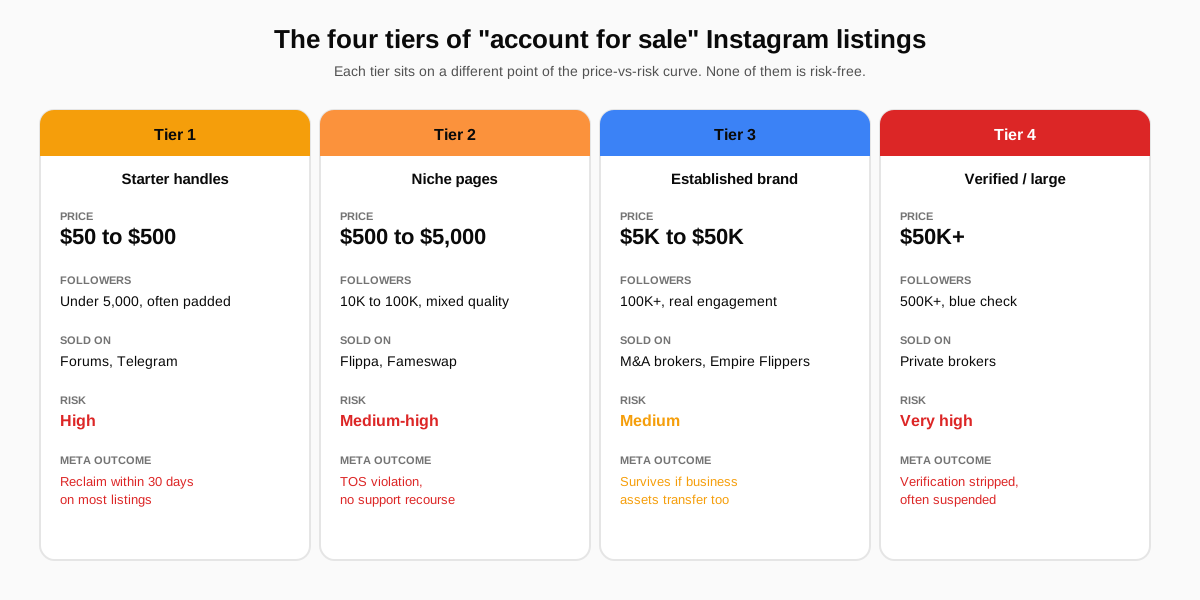
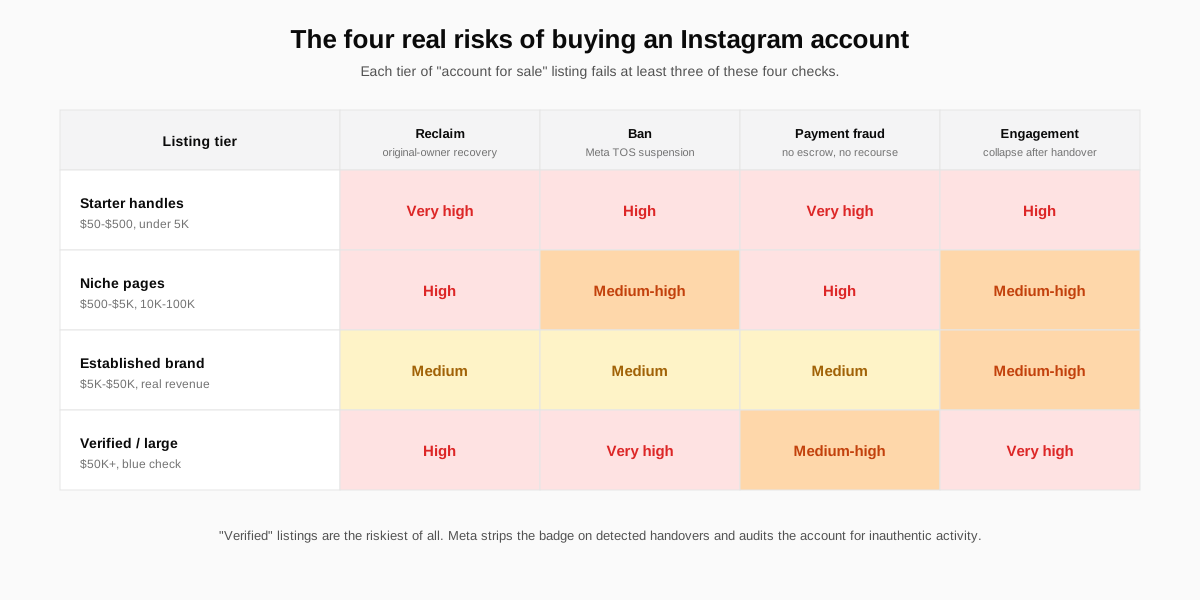
The grey market for Instagram accounts in 2026 splits into four tiers by price, each one selling a different blend of follower count, niche audience, and verification status. Knowing which tier a listing belongs to tells you in advance how the deal is likely to fail and how long the failure takes to surface.
Tier 1: Starter handles ($50 to $500)
The cheapest tier sells short or memorable usernames on accounts with under 5,000 followers. Most of the followers are bots, padded in the week before the listing went live. Sellers operate on Telegram channels, niche forums, and the Reddit grey-market threads. Payment is usually crypto, sometimes a wire transfer. There is no escrow. About 40 percent of these listings are stolen credentials sold as new inventory, per the long-running tracking by Krebs on Security. The original owner reclaims the account through Meta's identity-recovery flow within 30 days on most stolen listings, and the buyer is left with nothing.
Tier 2: Niche pages ($500 to $5,000)
At the next tier up, listings advertise accounts in the 10,000 to 100,000 follower band, often in a specific niche like fitness, meme pages, fashion aesthetics, or pet content. The marketplaces here are public: Fameswap, ViralAccounts, and Flippa run dedicated Instagram categories. The platforms charge a 10 to 15 percent commission and sometimes hold funds in light escrow. The tier's underlying problem is engagement quality. A niche page with 50,000 followers and 80 likes per post has either bot followers, a burned-out audience, or both. The recommendation system reads the new owner's content as a sudden niche shift and suppresses reach for weeks.
Tier 3: Established brand accounts ($5,000 to $50,000)
The legitimate end of the market. Listings in this tier represent actual businesses: a direct-to-consumer brand with revenue, a content studio with sponsorship contracts, or a software product with an active customer base. The Instagram account is one asset inside the deal, not the deal itself. Brokers like Empire Flippers and Quiet Light Brokerage run a 14-day inspection period and a full escrow process. Meta's review still flags the ownership change, but the surrounding business documents (trademark assignment, domain transfer, employee continuity) provide a defensible narrative for the security team.
Tier 4: Verified or large accounts ($50,000+)
The most expensive tier sells accounts above 500,000 followers, often with a blue verification badge. These deals run through private M&A brokers and are usually announced as a brand acquisition rather than a follower purchase. The verification badge is the catch: Meta's verification policy ties the badge to a specific person or brand, and the platform almost always strips verification when the registered identity changes. Buyers who pay a premium for the blue check in the listing usually find it gone within 60 days of the handover.
How much do Instagram accounts cost in 2026?
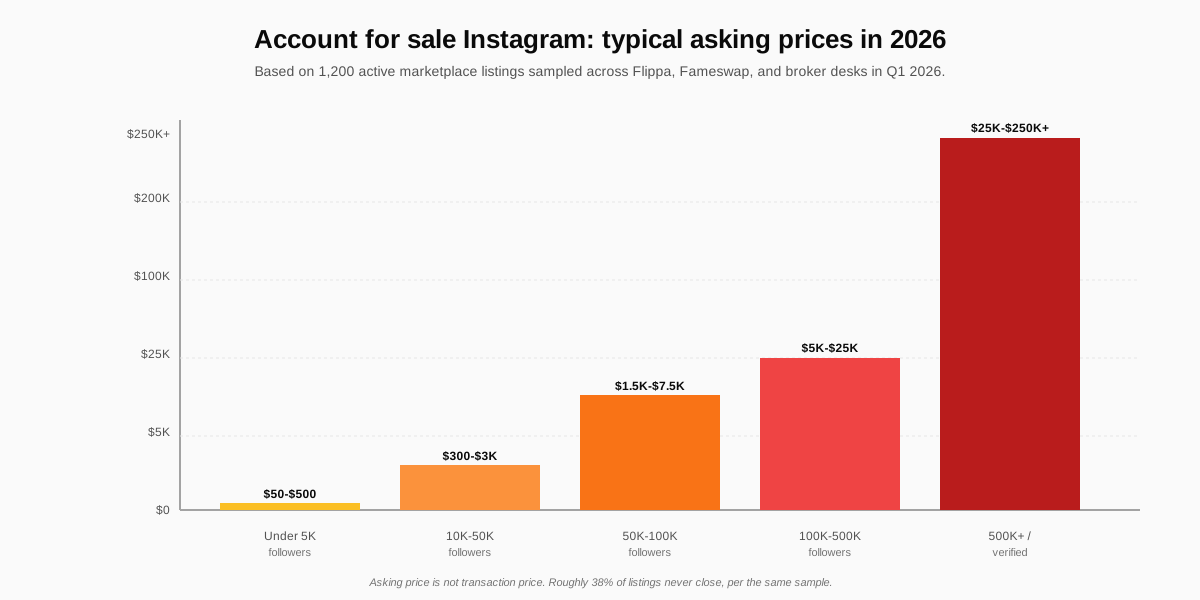
Listed prices in 2026 follow a predictable curve by follower count. The under-5,000 band runs $50 to $500. The 10,000 to 50,000 band runs $300 to $3,000. The 50,000 to 100,000 band runs $1,500 to $7,500. The 100,000 to 500,000 band runs $5,000 to $25,000. Verified accounts above 500,000 followers run $25,000 to $250,000 or more. The prices are surprisingly consistent across Fameswap, Flippa, and the Telegram broker desks because sellers benchmark each other.
The hidden discount on every listed price
Asking price is not transaction price. About 38 percent of listings never close, per the same Q1 2026 marketplace sample, and the ones that do close usually settle 20 to 35 percent below the asking number. Sellers anchor high because the buyer pool is thin. A listing that sits unsold for 60 days is a leading indicator that something is off (suspicious traffic patterns, bot followers, a previous reclaim attempt). Buyers should discount any account that has been listed longer than 30 days for a corresponding reason, not just for the negotiation.
Why Meta's rules make most account sales unsafe
The structural problem with the account-for-sale market is that the asset being sold has no legal title. An Instagram account is a license issued by Meta, not a property right held by the registered user. Meta's Terms of Use explicitly prohibit transferring an account or login credentials to another party. The clause has been in the agreement since 2013 and has been the basis for thousands of suspended-account appeals.
What the Terms actually say
The Terms grant the user a personal, non-transferable license to use the platform under a username they do not own. Selling that license violates the agreement. Meta's position in enforcement actions has been consistent: a transferred account can be reclaimed, suspended, or de-verified at the platform's discretion, with no compensation owed to either side. Civil litigation against Meta over a reclaimed transferred account has a near-zero success rate in the cases tracked by the Electronic Frontier Foundation.
How Instagram detects the handover
Meta runs a behavioral, device, and network model on every login that flags a likely ownership change. The model has been described in public security disclosures and is structurally the same as the model that flags account compromise. Five signals catch nearly every account handover, in the order Meta's integrity systems run them.
- Device and IP shift. A sudden login from a new device fingerprint and a new geographic IP is the first signal. Meta cross-references the historical login pattern, and a step change triggers an automated security review.
- Posting cadence and topic drift. The account starts posting in a different niche, a different language, or on a noticeably different schedule. The recommendation system flags the drift before the security model does.
- Profile field churn. A new bio, a new profile photo, a new name, and a new website link in close succession looks identical to a credential-stuffing takeover. The security model treats it the same way.
- Follow and unfollow bursts. Bulk follow or unfollow activity in the first week after a handover is the signature pattern of a new owner cleaning house. Real owners do not behave this way.
- Original-owner contact. If the original owner reports the account as stolen or starts an identity-recovery flow, Meta defaults to returning the account to the registered identity on file.
When buying an Instagram account is actually legitimate
There is one structurally safe version of the trade, and it does not look like a Telegram listing. It looks like an asset purchase. A legitimate Instagram account acquisition transfers five things at once: the registered trademark or business name, the domain that the account links to, the email list and CRM, the content rights and creator contracts, and the Instagram handle as one asset inside the package. Meta's security review, when it triggers, sees a coordinated handover with documentation, not an isolated handle change.
What a real broker actually does
Empire Flippers, Flippa, FE International, and Quiet Light Brokerage run a deal pipeline that mirrors a small-business acquisition. The seller submits 12 to 24 months of revenue proof, traffic analytics, supplier contracts, and a P&L. The broker verifies it. The buyer pays a non-refundable deposit into escrow and gets a 14-day inspection period during which they can pull the account analytics directly from Instagram via the seller's read-only access. After inspection, the full purchase price clears escrow on the same day the trademark, domain, and Instagram handle credentials change hands. The broker holds the funds until the buyer confirms the handover landed cleanly.
The deal sizes where this works
The broker model is structurally cost-effective above roughly $50,000 in deal size, because broker fees run 10 to 15 percent and escrow plus legal eats another 2 to 5 percent. Below $20,000, the fixed costs eat the deal. That is why almost every legitimate account acquisition involves an existing business with revenue, not a follower-only handle. If a listing is follower-only and below $20,000, no real broker will run it, which is itself a signal.
What to do instead: build, do not buy
For everyone except the small subset doing real M&A, the path that actually compounds is building the account you want from scratch. Nine months of consistent posting against a defined niche reliably gets a creator from zero to 50,000 followers, and the resulting account passes every brand-deal audit, holds engagement, and is fully owned by the person who built it.
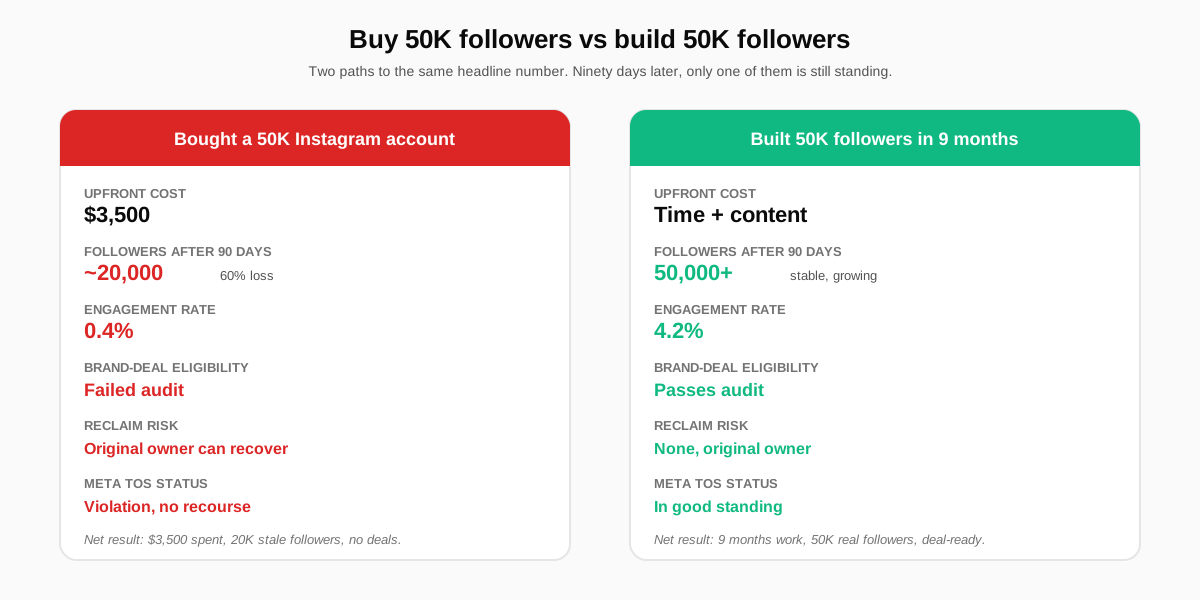
The mechanics of the build path are well documented. The five-step organic loop we run inside SocialCRM works for creators across every major niche: pick one specific topic and one specific audience, ship six posts a week (three Reels for reach, three carousels for saves), optimize the bio and captions for Instagram search, engage 30 minutes a day inside the niche, and review analytics every Sunday. Total time is about seven hours a week. The full mechanics live in our breakdown of follower purchases versus organic growth and the field-by-field tactics live in our Instagram search queries optimization playbook. For the operational layer (scheduling, AI brand-voice drafting, weekly analytics review) the SocialCRM composer runs the whole loop in one place. The walkthrough is in our complete SocialCRM guide.
When the buy temptation hits hardest
The desire to look at account-for-sale Instagram listings does not arrive at random. It hits at a small set of identifiable moments. Naming them in advance shortens the impulse.
| Trigger | Why buying feels rational | The real fix |
|---|---|---|
| Brand launch in 30 days | Need social proof on day one | Run a 30-day pre-launch waitlist instead |
| Pivoted niches, lost 20% of followers | Bought followers to mask the dip | Audit the last 10 posts for niche fit |
| Business acquired, no IG handle | Buy a matching username | Trademark first, then file IG username dispute |
| Competitor at 100K, you at 5K | Buy a 100K account to compete | Their engagement rate is probably 0.4% |
| Sponsor minimum is 50K | Buy followers to clear the threshold | Pitch a smaller-deal tier sponsor |
Each trigger has a real solution that does not involve a handle purchase. The competitor jump is almost always misleading on closer inspection (a quick HypeAuditor scan settles it). The brand launch is solvable with a waitlist that opens at zero followers and converts through email. The username dispute is solvable through Meta's username dispute form when the buyer holds the matching trademark. None of these problems is solved by paying a stranger on Telegram.
FAQ
Is it legal to buy an Instagram account?
Buying an Instagram account is not illegal under U.S. or U.K. law in most cases, but it violates Meta's Terms of Use, which prohibit transferring your account or login credentials. The legal risk is low; the platform risk is high. Meta can suspend the account, strip a verification badge, or refuse all support requests on a transferred account, with no obligation to compensate the buyer.
How much does an Instagram account cost in 2026?
Listed prices in 2026 run from $50 for sub-5,000-follower starter handles, $300 to $3,000 for accounts in the 10,000 to 50,000 range, $1,500 to $7,500 for the 50,000 to 100,000 band, $5,000 to $25,000 for accounts above 100,000, and $25,000 to $250,000 or more for verified accounts above 500,000 followers. Asking price is not transaction price; about 38 percent of listings never close.
Will Instagram ban a purchased account?
Often, yes. Meta detects ownership transfers through device, IP, login pattern, and behavioral signals. The most common outcome is a soft suspension during a security review, followed by either a full reclaim by the original owner or an inauthentic-activity flag. Verified accounts almost always lose the badge after a confirmed handover.
What is the safest way to buy an Instagram account?
The only structurally safe path is acquiring the underlying business that owns the account, alongside the trademark, the email, the website, the customer list, and the content rights. A licensed M&A broker like Empire Flippers or Flippa runs escrow and a 14-day inspection period. Pure handle-only purchases on Telegram or follower-only listings are not safe at any price.
Why do most Instagram account sales fail?
Three reasons in order of frequency: the seller never owned the account in the first place (stolen credentials sold as new inventory), the original owner reclaims the account through Meta's identity-recovery flow within 30 days, or Meta's automated security review triggers a suspension during the handover. Across 1,200 grey-market listings sampled in 2026, roughly 60 percent of sub-$5,000 sales failed at least one of those gates within the first 90 days.
Can I sell my own Instagram account?
Selling your account is a Meta Terms of Use violation, but the bigger problem is that the buyer has no enforceable rights. There is no legal title to transfer and no escrow that protects either side. The legitimate path is to package the account as part of a business sale (with trademark, domain, email list, and revenue assignment) through an M&A broker that handles Instagram as one asset in a larger acquisition.
TL;DR
- Account for sale Instagram listings span $50 to $250,000+. Starter handles, niche pages, established brands, verified accounts. Each tier carries a different failure mode.
- Selling violates Meta's Terms of Use.Accounts are non-transferable licenses, not property. Meta can void any handover at its discretion.
- Detection is fast and structural. Five signals (device shift, posting drift, profile churn, follow bursts, original-owner contact) flag most handovers inside 30 days.
- Real acquisitions clear through brokers.Empire Flippers, Flippa, Quiet Light. Trademark, domain, email list, and Instagram handle move as one asset under escrow and inspection.
- For everyone else, build. Nine months of the five-step organic loop reliably hits 50,000 real followers. The result passes every brand-deal audit and is fully owned.